Home > Blog > Cutting parameters for HSS and solid carbide circular saw cutters: a practical guide
Cutting parameters for HSS and solid carbide circular saw cutters: a practical guide
Publié le 4 June 2026
The success of a sawing operation depends as much on the choice of tool as on the cutting parameters applied. A mill-saw perfectly suited to the application may see its service life severely reduced if the cutting speed or feed rate are poorly defined.
Conversely, optimized parameters increase productivity, improve surface finish and significantly extend tool life.
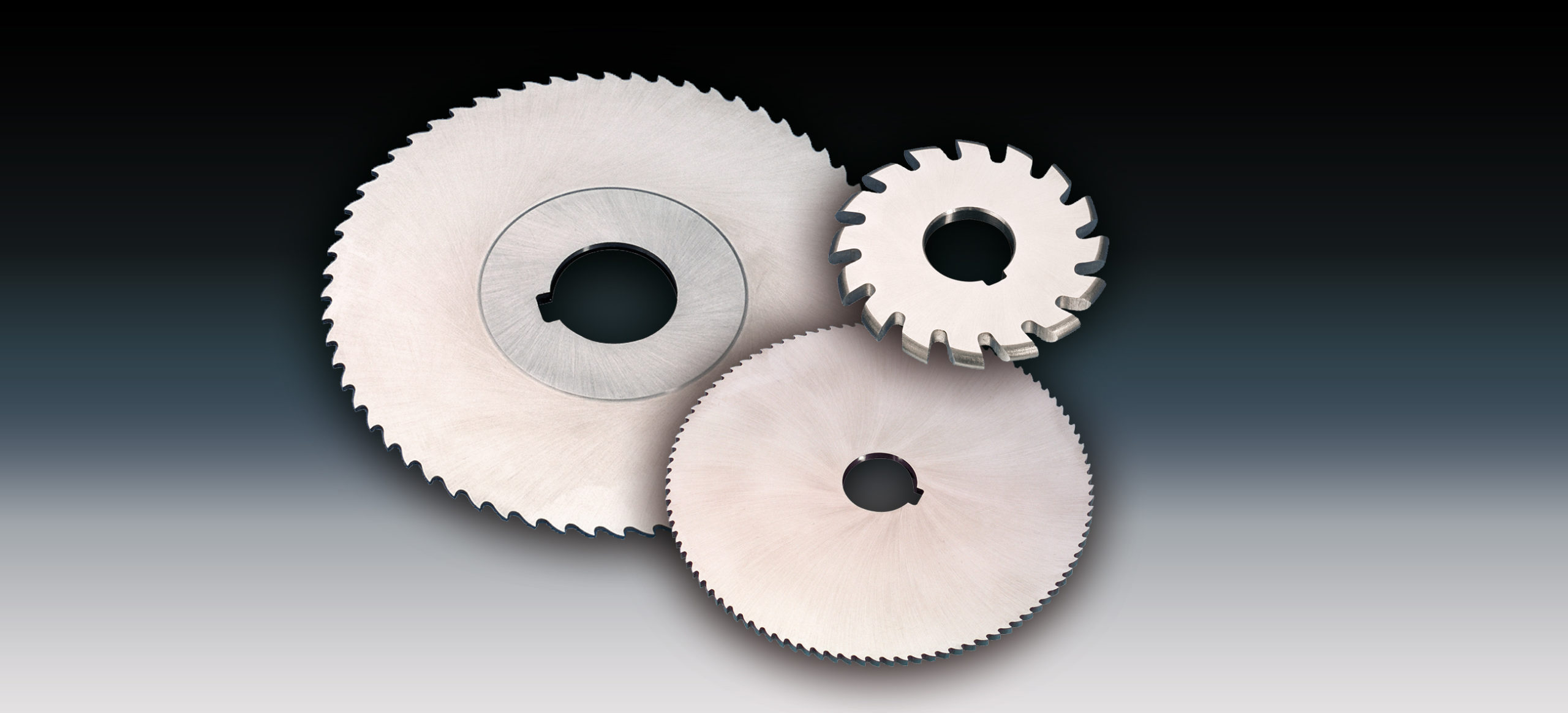
In this article, we present the main parameters to be taken into account when using HSS and solid carbide circular sawbores.
The three fundamental parameters
Cutting speed (Vc)
Cutting speed corresponds to the linear speed at which the cutter teeth penetrate the material.
It is expressed in meters per minute (m/min).
This value depends mainly on :
of the material to be machined ;
of its hardness;
tool grade;
flange quality;
machine type.
Too high a cutting speed generally results in overheating, premature wear and loss of cutting quality.
Conversely, too low a speed reduces productivity and can lead to excessive cutting effort.
Rotational speed (n)
Rotational speed is expressed in revolutions per minute (rpm).
It is calculated from the cutting speed and the diameter of the cutter. At the same cutting speed, a small-diameter cutter will turn faster than a large-diameter cutter.
Feed per tooth (fz)
The feed per tooth represents the chip thickness removed by each tooth as it passes through the material.
It is expressed in millimeters per tooth (mm/dent).
For HSS and solid carbide circular saw cutters, a value of between 0.005 and 0.02 mm/dent is generally a suitable basis for setting, depending on the material and application.
Insufficient feed often results in excessive tooth friction, while excessive feed increases cutting forces and the risk of breakage.
Recommended cutting parameters for HSS saw mills
HSS saw cutters offer excellent versatility for steel, stainless steel, cast iron and non-ferrous metals.
Material
Cutting speed (Vc)
Steel up to 50 daN/mm² (1.5 lb/ft²)
25 to 50 m/min
50 to 80 daN/mm² steel
15 to 30 m/min
80 to 100 daN/mm² steel
10 to 20 m/min
100 to 130 daN/mm² steel
5 to 10 m/min
Stainless steel and titanium alloys
10 to 25 m/min
Grey cast iron
15 to 25 m/min
Copper, brass, bronze
100 to 350 m/min
Aluminum
100 to 400 m/min
Plastics
400 to 800 m/min
Soft materials such as aluminum or plastic allow much higher speeds than high-alloy steels or stainless steel.
Recommended cutting parameters for solid carbide end mills
Thanks to their high hardness and excellent wear resistance, solid carbide sawbores enable significantly higher cutting speeds.
Material
Cutting speed (Vc)
Steel up to 50 daN/mm² (1.5 lb/ft²)
120 to 200 m/min
50 to 80 daN/mm² steel
100 to 200 m/min
80 to 100 daN/mm² steel
60 to 150 m/min
100 to 130 daN/mm² steel
40 to 100 m/min
Stainless steel and titanium
50 to 100 m/min
Grey cast iron
60 to 120 m/min
Copper, brass, bronze
200 to 400 m/min
Aluminum
400 to 800 m/min
Plastics
600 to 1000 m/min
Depending on the application, cutting speeds can be multiplied by 3 to 5 compared with HSS. This capability increases productivity, improves cut quality and reduces cutting costs per part.
Adapt cutting parameters to your industry
The values for cutting speed, rotational speed and feed rate presented above provide an excellent basis for adjustment. However, actual cutting conditions vary greatly depending on the industry, materials used and production objectives.
Tube and section industry
Cutting metal tubes and profiles is one of the most common applications for HSS and solid carbide circular saw blades.
The challenges are generally to limit burrs, avoid deformation of thin walls and guarantee excellent cut perpendicularity.
In this type of application, clamping, machine rigidity and gear selection play just as important a role as cutting parameters.
Bar turning and precision mechanics
The bar turning, watchmaking, connector technology and precision mechanics sectors place high demands on surface finish and dimensional tolerances.
The wrong feed rate can cause burrs, cutting defects or premature tool wear.
Precise adjustment of the feed rate per tooth is therefore particularly important to guarantee consistent quality.
Automotive industry
The automotive industry frequently uses alloyed, case-hardened or heat-treated steels with high mechanical strength.
These materials often require the use of coated saw-cutters and rigorously controlled cutting parameters to maximize tool life and maintain high production rates.
Aerospace industry
Titanium alloys, special stainless steels and certain high-performance materials present significant machining difficulties.
These materials have difficulty dissipating heat, and place heavy loads on cutting edges.
Appropriate cutting speeds and geometry are essential to limit heat build-up and preserve tool life.
Copper, brass and connector industry
Copper alloys generally allow much higher cutting speeds than steels.
However, cutting quality requirements are particularly high in the connector and electronics sectors, where the slightest burr can lead to costly rework operations.
An application-based approach
There are no universal parameters applicable to all situations.
The recommended values must always be adapted according to :
material ;
of the section to be cut ;
tool geometry ;
machine type ;
of the clamping system ;
productivity targets.
Field experience and tests carried out under real production conditions remain the best means of optimizing the long-term performance of an HSS or solid carbide circular cutter.
A concrete example
Let's take a Ø80 mm solid carbide milling cutter for machining structural steel.
The recommended speed is around 600 rpm.
For an HSS milling cutter of the same diameter and for the same material, the recommended rotation speed is around 140 rpm.
This example perfectly illustrates the productivity gains made possible by solid carbide.
Influence of gear geometry
A and AW serrations
A and AW teeth generally use smaller cutting angles.
For example:
Steel up to 80 daN/mm²: cutting angle 5°; draft 15°.
Titanium: cutting angle 2°; draft 10°.
Aluminium: cutting angle 8°; draft 20°.
B and BW gear teeth
B and BW teeth feature more aggressive cutting angles.
For example:
Steel up to 80 daN/mm²: 15° cutting angle
Copper: 20° cutting angle
Aluminium: 20° cutting angle
The choice of geometry must always be based on the material, the cross-section to be cut and the rigidity of the installation.
How to calculate the feed rate of a circular saw?
The working advance can be determined using the following formula:
Vf = (1000 × fz × Vc) / T
with :
Vf : machine feed (mm/min)
fz : feed per tooth (mm/tooth)
Vc : cutting speed (m/min)
T : tooth pitch (mm)
This formula makes it possible to quickly establish a consistent setting when setting up a sawing operation.
Conclusion
The choice of cutting parameters is a decisive factor in fully exploiting the performance of a circular sawmill.
HSS saw cutters are an economical and versatile solution for many applications, while solid carbide saw cutters enable much higher levels of productivity thanks to significantly higher cutting speeds.
For best results, parameters must always be adapted to the material, the tool geometry, the machine used and the actual machining conditions.
How do you find the right circular saw blade for your application?
Published on 28 October 2025
Do you have a cutting problem, irregular quality or a tool that wears out too quickly? Are you experiencing cutting difficulties, uneven quality or rapid blade wear?At Caleyron Industries, we know that no two situations are the same. Every machine, every material and every production process has its own specificities. That's why we offer our […]
The choice of a circular saw blade depends on the material you're going to cut, the type of cut you want to make and the specifications of your machine.
Circular saw blade: which one for non-ferrous metals?
Published on 15 April 2025
When it comes to cutting non-ferrous metals such as aluminum, copper, zinc or titanium, the choice of circular saw blade is all the more important. These materials have specific characteristics that influence the quality and precision of the cut, depending on the blade used. Using an unsuitable blade can lead to overheating, burrs or premature […]